
Description
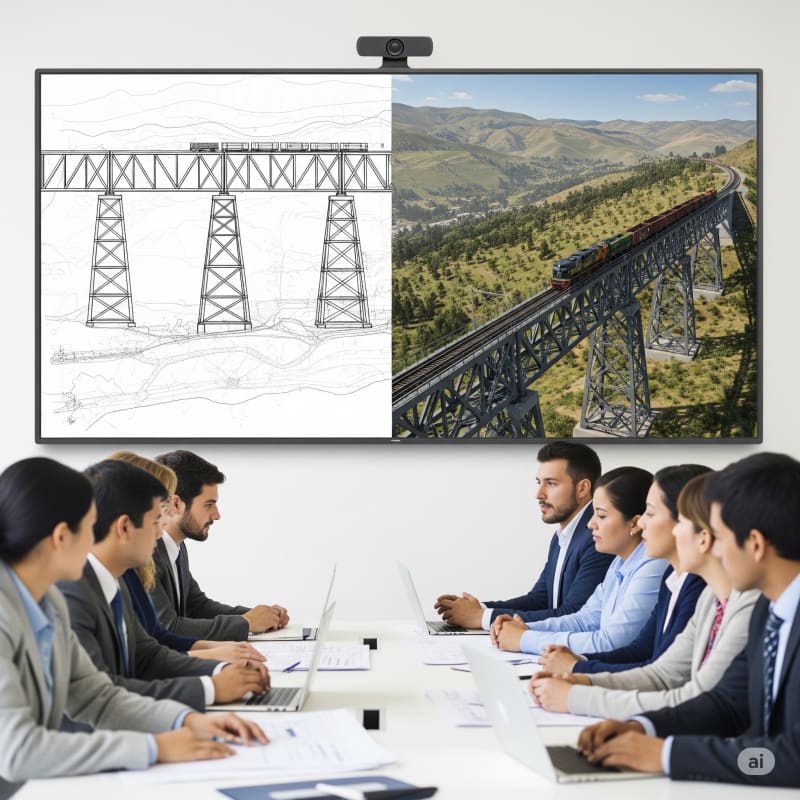
This project focused on the structural design of three vital metal bridges for the rehabilitation of the Cochabamba – Arani railway section, with spans of 7.20 m, 8.80 m, and 13.50 m. The structures were conceived under strict criteria of functionality and resistance for railway traffic. To ensure technical viability and structural performance, basic studies of topography, geotechnics, geology, hydrology, and hydraulics were carried out, along with the preparation of costs and budget. The design and structural calculation of each metal bridge were executed following a rigorous approach to ensure its integrity and long-term performance. It began with the definition of the optimal structural system, considering configurations of main beams and the bracing system, to support railway loads (live and dead) and environmental loads (wind, seismic). The current Bolivian regulations and relevant international standards for the design of railway bridges were applied, which included the evaluation of loads according to the specifications of AREMA (American Railway Engineering and Maintenance-of-Way Association). The structural analysis was performed using finite element software (FEM) to model the complex geometry of the bridges and simulate their behavior under various load combinations. This allowed for the precise determination of stresses, deformations, and displacements in each structural component. Special attention was paid to the design of connections (bolted or welded), which are critical points in metal structures, ensuring the efficient transfer of stresses. Similarly, global and local stability checks (buckling of webs and flanges, lateral-torsional stability of beams) were performed to prevent failures due to instability. The selected metal materials met resistance, ductility, and weldability specifications, guaranteeing the quality and durability of the structure. Finally, this intervention is fundamental to strengthening the existing railway infrastructure, which not only improves connectivity but also increases the reliability of the transportation system in the region.
Gallery